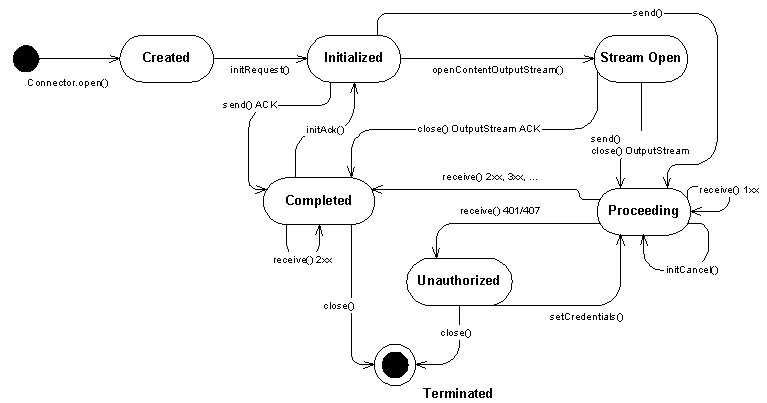
SipClientConnection has following state diagram:
|
|||||||||
| PREV CLASS NEXT CLASS | FRAMES NO FRAMES | ||||||||
| SUMMARY: NESTED | FIELD | CONSTR | METHOD | DETAIL: FIELD | CONSTR | METHOD | ||||||||
public interface SipClientConnection
SipClientConnection represents a SIP client transaction.
Applications can create a new SipClientConnection with Connector or
SipDialog object.
The SipClientConnection has following state diagram:
SipClientConnection created using ConnectorinitRequest(...) or
initAck() or
initCancel() or
SipDialog.getNewClientConnection(...)
OutputStream opened with
openContentOutputStream(). Opening InputStream for
received response does not trigger state transition.initCancel() can be
called, which will spawn a new SipClientConnection
which is in Initialized statesetCredentials() method. After this the SipClientConnection is back in Proceeding state.Note: The state diagram of SipClientConnection
differs from the state diagram of SIP client transaction, which can be found in
RFC 3261 [1] p.128-133
Following methods are restricted to a certain state. The table shows the list of restricted methods allowed in each state.
initRequestaddHeadersetHeaderremoveHeadersetRequestURIopenContentOutputStreamsendenableRefreshsetCredentialsOutputStream and SipConnection.sendreceiveopenContentInputStreaminitCancelopenContentInputStreaminitAckreceivesetCredentialsSipException.INVALID_STATE if that is specified to the
method and IOException for those methods (e.g. methods of
Input/OutputStream) that does not have SipException
specified. Methods that don't throw checked exceptions return
without any action or return null as appropriate.Following methods can be called in every state. The functionality is defined by the method depending on the information availability.
null in
the Terminated state.
getHeadergetHeadersgetRequestURIgetMethodgetStatusCodegetReasonPhrasegetDialogsetListener // can not be called in Terminated statesetErrorListener // can not be called in Terminated stateclose // causes state transition to Terminated stateThe example below illustrates the usage of SIP client connection: opening, sending one request (MESSAGE) and receiving response:
 public void sendTextMessage(String msg) {
    SipClientConnection sc = null;
    try {
       sc = (SipClientConnection) Connector.open
                     ("sip:sippy.tester@host.com:5060");
       sc.initRequest("MESSAGE", null);
       sc.setHeader("From", "sip:user@host.com");
       sc.setHeader("Subject", "testing...");

       // write message body
       sc.setHeader("Content-Type", "text/plain");
       sc.setHeader("Content-Length", Integer.toString(msg.length()));
       OutputStream os = sc.openContentOutputStream();
       os.write(msg.getBytes());
       os.close(); // close stream and send the message

       // wait maximum 15 seconds for response
       boolean ok = sc.receive(15000);

       if(ok) {  // response received
           if(sc.getStatusCode() == 200) {
              // handle 200 OK response
           } else {
              // handle possible error responses
           }
       }
       sc.close();
     } catch(Exception ex) {
          // handle Exceptions
     }
 }
Following class shows the same example using callback listener interface:
 public class SipClient implements SipClientConnectionListener {
    public void sendTextMessage(String msg) {
       SipClientConnection sc = null;
       try {
          sc = (SipClientConnection) Connector.open
                        ("sip:sippy.tester@host.com:5060");
          sc.setListener(this);
          sc.initRequest("MESSAGE", null);
          sc.setHeader("From", "sip:user@host.com");
          sc.setHeader("Subject", "testing...");
          sc.setHeader("Content-Type", "text/plain");
          sc.setHeader("Content-Length", Integer.toString(msg.length()));
          OutputStream os = sc.openContentOutputStream();
          os.write(msg.getBytes());
          os.close(); // close stream and send message
       } catch(Exception ex) {
         // handle Exceptions
       }
      return;
    }

    public void notifyResponse(SipClientConnection scn) {
       try {
          // retrieve the response received
          sc.receive(0); // does not block response is there
          if(sc.getStatusCode() == 200) {
             // handle 200 OK response
          } else {
             // handle possible error responses
          }
          sc.close();
       } catch(Exception ex) {
             // handle Exceptions
       }
    }
 }
SipClientConnectionListener,
SipConnectionNotifier,
SipServerConnection,
SipDialog.getNewClientConnection(String)| Method Summary | |
|---|---|
int |
enableRefresh(SipRefreshListener srl)
Enables the refresh for the request to be sent. |
void |
initAck()
Convenience method to initialize SipClientConnection
with SIP request method ACK. |
SipClientConnection |
initCancel()
Convenience method to initialize SipClientConnection
with SIP request method CANCEL. |
void |
initRequest(java.lang.String method,
            SipConnectionNotifier scn)
Initializes SipClientConnection to a specific SIP request
method (REGISTER, INVITE, MESSAGE, REFER, ...). |
boolean |
receive(long timeout)
Receives SIP response message. |
void |
setCredentials(java.lang.String[] usernames,
               java.lang.String[] passwords,
               java.lang.String[] realms)
Sets multiple credential triplets for possible digest authentication. |
void |
setCredentials(java.lang.String username,
               java.lang.String password,
               java.lang.String realm)
Sets credentials for possible digest authentication. |
void |
setListener(SipClientConnectionListener sccl)
Sets the listener for incoming responses. |
void |
setRequestURI(java.lang.String URI)
Sets Request-URI explicitly. |
| Methods inherited from interface javax.microedition.sip.SipConnection |
|---|
addHeader, getDialog, getHeader, getHeaders, getMethod, getReasonPhrase, getRequestURI, getStatusCode, openContentInputStream, openContentOutputStream, removeHeader, send, setErrorListener, setHeader |
| Methods inherited from interface javax.microedition.io.Connection |
|---|
close |
| Method Detail |
|---|
int enableRefresh(SipRefreshListener srl)
                  throws SipException
Enables the refresh for the request to be sent. The method
return a refresh ID, which can be used to update or stop
the refresh. Passing null as listener does not clear a
previously set listener and does not stop a refresh. Refreshing should
be stopped by calling stop. Calling enableRefresh for
the second time with a non-null value does not overwrite the previously
set listener. In this case the previously set listener remains valid,
and the method throws SipException.INVALID_STATE.
srl - callback interface for refresh events, if this is null
the method returns 0 and refresh is not enabled.
SipException - INVALID_STATE if the
refresh can not be enabled in this state.SipRefreshHelper
void initAck()
             throws SipException
Convenience method to initialize SipClientConnection
with SIP request method ACK. ACK can be applied only to INVITE
request. The method is available when a successful final response (2xx)
has been received.The header fields of the ACK are constructed in the same way as for any request sent
within a dialog with the exception of the CSeq and the header fields related to authentication
(RFC 3261 [1], p.82). The Request-URI and headers will be initialized automatically. After this the SipClientConnection is
in Initialized state.
At least Request-URI and following headers will be set by the method (RFC 3261 [1] 12.2.1.1 Generating the Request p.73 and 8.1.1 Generating the Request p.35). See also RFC 3261 [1] 13.2.2.4 2xx Responses (p.82)
    Request-URI  // system uses the remote target and route set to
                    build the Request-URI
    To           // remote URI from the dialog state + remote tag
                    of the dialog ID
    From         // local URI from the dialog state + local tag of
                    the dialog ID
    CSeq         // the sequence number of the CSeq header field
                    MUST be the same as the INVITE being
                    acknowledged, but the CSeq method MUST be ACK.
    Call-ID      // Call-ID of the dialog
    Via          // Via header field indicates the transport used
                    for the transaction and identifies the location
                    where the response is to be sent
    Route        // system uses the remote target and route set
                    (if present) to build the Route header
    Contact      // SHOULD include a Contact header field in any
                    target refresh requests within a dialog, and
                    unless there is a need to change it, the URI
                    SHOULD be the same as used in previous
                    requests within the dialog
    Max-Forwards // header field serves to limit the number of
                    hops a request can transit on the way to its
                    destination.
These headers will be set on behalf of the user by the implementation
the latest when sending the request. It implies that the header values
may not be available for reading right after the initAck
method returns. The user may also set (overwrite) these headers, in this
case the values set by the user take precedence over the values set by
the implementation.
The following rules also apply:
For error responses (3xx-6xx) the ACK is sent automatically by the system in transaction level. If the user initializes an ACK which has already been sent an Exception will be thrown.
The SipClientConnection remains in Completed state
if sending ACK fails and there is forking case. It allows trying to send
ACK again, wait for more 2xx responses or close the connection. If the
application (after investigating the error code) finds out that the
error is irrevocable, it can close the connection.
SipException - INVALID_STATE if the request can not be set, because of wrong state,
INVALID_OPERATION if the ACK request can not be initialized for other reason (already sent or the original request is non-INVITE).
SipClientConnection initCancel()
                               throws SipException
Convenience method to initialize SipClientConnection
with SIP request method CANCEL. The method is available when a provisional response has been received.
The CANCEL request starts a new transaction,that is why the method returns a new SipClientConnection.
The CANCEL request will be built according to the original INVITE request
within this connection. The RequestURI and headers will be initialized
automatically. After this the SipClientConnection is in
Initialized state. The message is ready to be sent.
The following information will be set by the method:
    Request-URI  // copy from original request
    To           // copy from original request
    From         // copy from original request
    CSeq         // same value for the sequence number as was
                    present in the original request, but the
                    method parameter MUST be equal to "CANCEL"
    Call-ID      // copy from original request
    Via          // single value equal to the top Via header field
                    of the request being cancelled
    Route        // If the request being cancelled contains a Route
                    header field, the CANCEL request MUST include
                    that Route header field's values
    Max-Forwards // header field serves to limit the number of hops
                    a request can transit on the way to its
                    destination.
These headers will be set on behalf of the user by the implementation
the latest when sending the request. It implies that the header values
may not be available for reading right after the initCancel
method returns. The user may also set (overwrite) these headers, in this
case the values set by the user take precedence over the values set by
the implementation.
Reference RFC 3261 [1] p.53-54
Note: CANCEL request SHOULD NOT be sent to cancel a request other than INVITE.
SipClientConnection with preinitialized CANCEL request.
SipException - INVALID_STATE if the request
can not be set, because of wrong state (in SipClientConnection)
or the system has already got a final response (even if not read with
receive() method). INVALID_OPERATION if CANCEL method can not
be applied to the current request method.
void initRequest(java.lang.String method,
                 SipConnectionNotifier scn)
                 throws SipException
Initializes SipClientConnection to a specific SIP request
method (REGISTER, INVITE, MESSAGE, REFER, ...). The methods are defined in
the RFC 3261 [1] and extension specifications from SIP WG and
SIMPLE WG [2][3][4][5][6]. Methods belonging to an already established
dialog (BYE, NOTIFY, PRACK, UPDATE)
should be created using SipDialog.getNewClientConnection()
instead of this method.
The default RequestURI and headers will be initialized
automatically. After this the SipClientConnection is in Initialized state.
The initialized request can be associated with an opened SipConnectionNotifier.
Initialization of some headers depends on how the associated SipConnectionNotifier is initialized.
SipConnectionNotifier in shared mode.
SipConnectionNotifier is given as the second parameter and it is
in shared mode the headers From, Contact are set according
to the terminal SIP settings and the currently active SIP user identity.Example values:
From: "Mr. Watson" <sip:watson@worcester.bell.com>Contact: "Mr. Watson" <sip:watson@172.21.55.69:5060>SipConnectionNotifier in dedicated mode.
SipConnectionNotifier is in dedicated mode the SIP identity
is not known by the system. Therefore the header From is preset to an
anonymous URI. The header Contact will be preset according to the
SipConnectionNotifier properties, where the
user part is set to some some default value selected by the system.Example values:
From: "Anonymous" sip:thisis@anonymous.invalidContact: sip:user@172.21.55.69:5060SipConnectionNotifier is in
dedicated mode or not set at all (= null)
the user is responsible of managing the SIP identity and thus also the SIP
registration. The user SHOULD overwrite the default values of From
for all requests and Contact header for requests like INVITE,
SUBSCRIBE, REGISTER and REFER.See also chapter "SipConnection: Opening new server connection"
for more details.
Headers that will be initialized are as follows:
    To           // To address constructed from SIP URI given in
                    Connector.open()
    From         // Set by the system. If SipConnectionNotifier is
                    given and it is in shared mode the value will
                    be set according the terminal SIP settings
                    (see Opening new server connection for more details).
                    If the SipConnectionNotifier is not given
                    (= null) or it is in dedicated mode the From
                    header MUST be set to a default value
                    e.g. anonymous URI (see RFC 3261 [1],
                    chapter 8.1.1.3 From).
    CSeq         // Set by the system
    Call-ID      // Set by the system
    Max-Forwards // Set by the system
    Via          // Set by the system
    Contact      // If SipConnectionNotifier is given the value is
                    set by the system for REGISTER, INVITE,
                    SUBSCRIBE and REFER. The value will be set
                    according to the terminal IP settings and the
                    SipConnectionNotifier properties. So the new
                    request is associated with the
                    SipConnectionNotifier. If the associated
                    SipConnectionNotifier is in the dedicated mode
                    the user part  is set to some default value
                    e.g. user.
                    Example (dedicated mode),
                      Contact: sip:user@172.21.55.69:5060
                    Example (shared mode),
                      Contact: "Mr X" <sip:mrx@172.21.55.69:5060>
These headers will be set on behalf of the user by the implementation
the latest when sending the request. It implies that the header values
may not be available for reading right after the initRequest
method returns. The user may also set (overwrite) these headers, in this
case the values set by the user take precedence over the values set by
the implementation.
If the application is using shared connections then it must set the
Accept-Contact header to all outgoing request except CANCEL and ACK. For
more details on how the message routing is handled based on the
Accept-Contact header see
"SipConnection: SIP Identity" and
"SipConnection: Routing the incoming request".
Reference RFC 3261 [1] p.35 (8.1.1 Generating the Request) and p.159 (20 Header Fields)
method - Name of the methodscn - SipConnectionNotifier to which the request will be associated. If scn is null
the request will not be associated to any user defined listening point.
java.lang.NullPointerException - if method is null
java.lang.IllegalArgumentException - if the method is invalid
SipException - INVALID_STATE if the request can not be set, because of wrong state in
SipClientConnection.Furthermore, ACK and CANCEL methods can not be initialized in Created state.
SipException - INVALID_OPERATION if the method argument is one of {BYE, NOTIFY, PRACK, UPDATE}.SipConnectionNotifier
boolean receive(long timeout)
                throws SipException,
                       java.io.IOException
Receives SIP response message. The receive method will update the
SipClientConnection with the last new received response.
The implementation places the responses in a FIFO queue and when this
method is called it fetches the
least recently arrived response which has not been fetched already.
If no message is received the method will block until something
is received or the specified amount of time has elapsed.
The SipClientConnection is always associated with the latest
response received successfully by calling the receive() method.
100 (Trying) responses for Non-INVITE transactions are not passed
up to the application level in receive() as these responses are
not explicitly required/expected by RFC 3261 and they are only useful
information for the transaction layer which takes care of request resends.
timeout - the maximum time to wait in milliseconds. 0 = do not
wait, just poll
true if response was received. Returns
false if the given timeout elapsed and no response was received.
java.io.IOException - if the message could not be received
or because of network failure. When an IOException is thrown
the connection moves to Terminated state. This exception is
thrown regardless of there is a SipErrorListener set
or not for the connection.
SipException - INVALID_STATE if the receive can not
be called because of wrong state.SipConnection.send()
void setCredentials(java.lang.String[] usernames,
                    java.lang.String[] passwords,
                    java.lang.String[] realms)
                    throws SipException
Sets multiple credential triplets for possible digest authentication. The username and password are specified for certain protection domain, which is defined by the realm parameter. The parameters of this method are 3 parallel arrays where usernames[i] and passwords[i] are interpreted as belonging to the protection domain in realms[i].
The credentials can be set:
SipClientConnection will be in Proceeding state.
The sequence is similar to Example 2.Implementations of this specification must support setting the credentials in both states described above.
See also SipClientConnection
state diagram.
See Authentication requirements for the authentication methods supported. This method was added to the API in version 1.1.0. This is necessary in the forking case when the received 401/407 error response may contain multiple authentication headers. For this case proper reauthentication was not possible in the Unauthorized state using the other form of this method which allows setting only a single triplet at a time.
When setting the credentials in the Unautorized state the
request is automatically resent which implies that the application is
unable to further modify the request headers before sending. Calling
getHeader immediately after setCredentials returns the
value of the authentication headers as they were set by the user before
sending the original request. The updated value of the authentication headers set by
the API implementation are not available at this point and can be
examined after a response is received to the reoriginated request.
usernames - array of user names. The array element username[i]
is for the protection domain realm[i].passwords - array of user passwords. The array element
passwords[i] is for the protection domain realm[i].realms - array of protection domains
java.lang.NullPointerException - if the usernames, passwords or
realms array is null or any of their elements is null
java.lang.IllegalArgumentException - if the length of the parameter arrays are
not equal or the length of at least one of them is 0.
SipException - INVALID_STATE if the credentials can not
be set in this state.
void setCredentials(java.lang.String username,
                    java.lang.String password,
                    java.lang.String realm)
                    throws SipException
Sets credentials for possible digest authentication. The username and password are specified for certain protection domain, which is defined by the realm parameter.
The credentials can be set:
SipClientConnection will be in Proceeding state.
See Example 2Implementations of this specification must support setting the credentials in both states described above.
See also SipClientConnection
state diagram.
See Authentication
requirements for the authentication methods supported. *
The application can set multiple credential triplets
(username, password, realm) for one SipClientConnection in the
Initialized state, however it can not set mulitple triplets in
the Unauthorized state using this method, as in this case the
request would be automatically resent after the first execution of this
method. For setting multiple credentials in the Unauthorized
state the application should use the SetCredentials(String[], String[],
String[]) method.
When setting the credentials in the Unautorized state the
request is automatically resent which implies that the application is
unable to further modify the request headers before sending. Calling
getHeader immediately after setCredentials returns the
value of the authentication headers as they were set by the user before
sending the
original request. The updated value of the authentication headers set by
the API implementation are not available at this point and can be
examined after a response is received to the reoriginated request.
The following simplified example shows how the credentials are set before sending the original request.
send()receive() to wait for the next response.receive() returns and the application calls getStatusCode(),
which returns 200.close().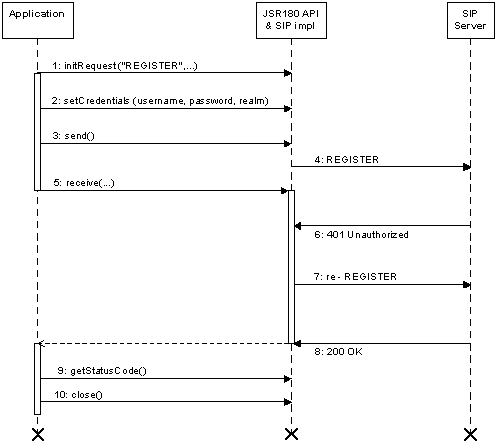
The following example shows how the credentials are set when the authentication response is received by the application.
send()receive() to wait for the next response.getStatusCode(), which returns now 401.setCredentials().receive() to wait for the next response.receive() returns and the application calls getStatusCode(),
which returns now 200.close().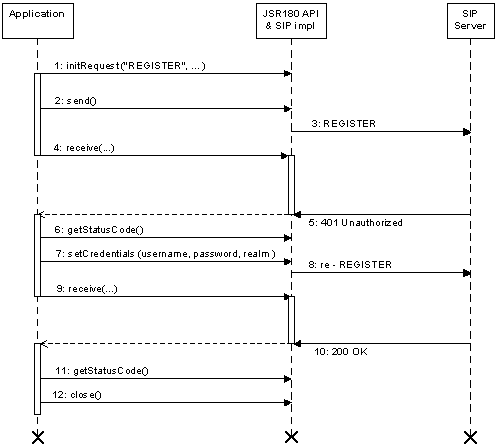
The following example code shows an outline how the application could send the REGISTER and handle the authentication responses as shown in the Example 2.
 public void doRegister(String username, String password, String realm) {

  SipClientConnection scc = null;
  SipConnectionNotifier scn = null;
  String contact = null;

  try {
      // open listener in application specific port 5080
      scn = (SipConnectionNotifier) Connector.open("sip:5080");

      // build the contact URI
      contact = new String("sip:user@"+scn.getLocalAddress()+
               ":"+scn.getLocalPort());

      // open client connection to the SIP registrar
      // in this case "host.com"
      scc = (SipClientConnection) Connector.open("sip:host.com");
      // initialize REGISTER with appropriate headers
      scc.initRequest("REGISTER", scn);
      scc.setHeader("From", "sip:user@host.com");
      scc.setHeader("To", "sip:user@host.com");
      scc.setHeader("Contact", contact);

      scc.send();

      boolean handled = false;
      int scode = 0;

      while(!handled) {
          SipHeader sh;
          // wait max 30 secs for response
          scc.receive(30000);
          scode = scc.getStatusCode();
          switch(scode)
          {
              case 401:
                  sh = new SipHeader("WWW-Authenticate",
                     scc.getHeader("WWW-Authenticate"));
                  realm = sh.getParameter("realm");
                  // strip the quotation marks
                  realm = realm.substring(1, realm.length()-1);
                  // here for example, prompt user for password
                  // for this realm
                  // set credentials to initiate re-REGISTER
                  scc.setCredentials(username, password, realm);
                  break;

              case 407:
                  sh = new SipHeader("Proxy-Authenticate",
                     scc.getHeader("Proxy-Authenticate"));
                  realm = sh.getParameter("realm");
                  // strip the quotation marks
                  realm = realm.substring(1, realm.length()-1);
                  // here for example, prompt user for password
                  // for this realm
                  // set credentials to initiate re-REGISTER
                  scc.setCredentials(username, password, realm);
                  break;

              case 200:
                  // handle OK response
                  handled = true;
                  break;
              default:
                  // handle other responses
                  handled = true;
          }
      }
      scc.close();
  } catch(Exception ex) {
      // handle Exceptions
  }
 }
username - username (for this protection domain)password - user password (for this protection domain)realm - defines the protection domain
java.lang.NullPointerException - if the username, password or
realm is null
SipException - INVALID_STATE if the credentials can not
be set in this state.
void setListener(SipClientConnectionListener sccl)
                 throws java.io.IOException
Sets the listener for incoming responses. If a listener is already set
it will be overwritten. Setting listener to null will remove
the current listener.
sccl - reference to the listener object. Value null will
remove the existing listener.
java.io.IOException - if the connection is closed
void setRequestURI(java.lang.String URI)
                   throws SipException
Sets Request-URI explicitly. If this operation is supported, Request-URI
can be set only in Initialized state. Empty or null argument removes Request-URI if set previously.
It is not mandated that this operation be supported, an implementation
may throw SipException.INVALID_OPERATION in any state.
URI - Request-URI
java.lang.IllegalArgumentException - MAY be thrown if the URI is invalid
SipException - INVALID_STATE if the Request-URI can not be set, because of wrong state,
INVALID_OPERATION if the Request-URI is not allowed to be set.
|
|||||||||
| PREV CLASS NEXT CLASS | FRAMES NO FRAMES | ||||||||
| SUMMARY: NESTED | FIELD | CONSTR | METHOD | DETAIL: FIELD | CONSTR | METHOD | ||||||||