|
|||||||||
| PREV CLASS NEXT CLASS | FRAMES NO FRAMES | ||||||||
| SUMMARY: NESTED | FIELD | CONSTR | METHOD | DETAIL: FIELD | CONSTR | METHOD | ||||||||
public interface SipDialog
SipDialog represents one SIP Dialog. The SipDialog
can be retrieved from a SipConnection object, when it is available
(at earliest after provisional 101-199 response).
Three SIP requests can open a dialog: INVITE, SUBSCRIBE/NOTIFY and REFER/NOTIFY. An implementation compliant to this specification must support all of the following ways of creating dialogs:
SipClientConnection
in the same dialog can be obtained
by calling
getNewClientConnection(String method) method. The dialog
is terminated when the transaction BYE-200 OK is completed.
For more information please refer to RFC 3261 [1], Chapter 12.SipClientConnection in the same dialog can be obtained
by calling
getNewClientConnection(String method) method. The dialog
is terminated when a notifier sends a NOTIFY request
with a "Subscription-State" of "terminated" and there are no other
subscriptions alive in this dialog.
For more information please refer to RFC 3265 [2], Chapter 3.3.4.SipClientConnection in the same dialog can be obtained
by calling
getNewClientConnection(String method) method. The dialog
is terminated when a notifier sends a NOTIFY request
with a "Subscription-State" of "terminated" and there are no other
subscriptions alive in this dialog.
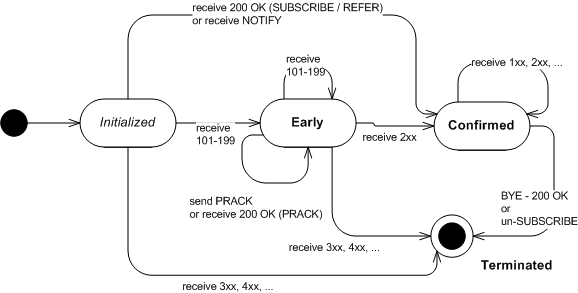
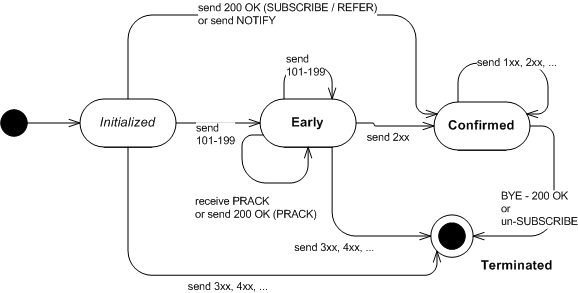
For more information please refer to RFC 3515 [6].SipDialog has following states (for both client and server side):
getNewClientConnection() can not be called in this
state.The SipDialog (client side) has following state diagram:
The SipDialog (server side) has following state diagram:
Following code example shows a simple example of using
SipDialog in conjunction with SipClientConnection
and SipServerConnection. SipDialog is used to
send subsequent SUBSCRIBE request as well as detecting if received NOTIFY
belongs to the same dialog (i.e. subscription). Further dialog information
like "Call-ID" or "remote tag" can be read from the subsequent
SipClientConnection as demonstrated.
 class SipDialogExample implements SipServerConnectionListener {

    SipDialog dialog;
    SipClientConnection scc;
    SipConnectionNotifier scn;
    String callID;
    String remoteTag;

    public void sendSubscribe() {
        try {
           scn = (SipConnectionNotifier) Connector.open("sip:");
           scn.setListener(this);
           scc = (SipClientConnection)
                 Connector.open("sip:UserB@host.com");
           scc.initRequest("SUBSCRIBE", scn);
           scc.setHeader("From", "sip:UserA@host.com");
           scc.setHeader("Accept", "application/pidf+xml");
           scc.setHeader("Event", "presence");
           scc.setHeader("Expires", "950");
           String contact = new String("sip:user@"+scn.getLocalAddress()
                            +":"+scn.getLocalPort());
           scc.setHeader("Contact", contact);
           scc.send();
           boolean resp = scc.receive(10000); // wait 10 secs for response
           if(resp) {
               if(scc.getStatusCode() == 200) {
                   dialog = scc.getDialog();
                   // initialize new SipClientConnection
                   scc = dialog.getNewClientConnection("SUBSCRIBE");
                   // read dialog Call-ID
                   callID = scc.getHeader("Call-ID");
                   // read remote tag
                   SipHeader sh = new SipHeader("To", scc.getHeader("To"));
                   remoteTag = sh.getParameter("tag");
                   // unSUBSCRIBE
                   scc.setHeader("Expires", "0");
                   scc.send();
               }
           } else {
               // didn't receive any response in given time
           }
        } catch(Exception ex) {
            // handle Exceptions
        }
    }

    public void notifyRequest(SipConnectionNotifier scn) {
        try {
           SipServerConnection ssc;
           // retrieve the request received
           ssc = scn.acceptAndOpen();
           // check if the received request is NOTIFY and it belongs
           // to our dialog

           if(ssc.getMethod().equals("NOTIFY") &&
              dialog.isSameDialog(ssc)) {
               ssc.initResponse(200);
               ssc.send();
           }else {
               // send 481 "Subscription does not exist"
               ssc.initResponse(481);
               ssc.send();
           }
        } catch(Exception ex) {
            // handle Exceptions
        }
    }
 }
SipConnection.getDialog()| Field Summary | |
|---|---|
static byte |
CONFIRMED
|
static byte |
EARLY
|
static byte |
TERMINATED
|
| Method Summary | |
|---|---|
java.lang.String |
getDialogID()
Returns the ID of the SIP Dialog. |
SipClientConnection |
getNewClientConnection(java.lang.String method)
Returns a new SipClientConnection in this dialog. |
byte |
getState()
Returns the state of the SIP Dialog. |
boolean |
isSameDialog(SipConnection sc)
Does the given SipConnection belong to this dialog. |
| Field Detail |
|---|
static final byte CONFIRMED
static final byte EARLY
static final byte TERMINATED
| Method Detail |
|---|
java.lang.String getDialogID()
Returns the ID of the SIP Dialog.
null if the dialog is terminated.
SipClientConnection getNewClientConnection(java.lang.String method)
                                           throws SipException
Returns a new SipClientConnection in this dialog. The returned
SipClientConnection will be in Initialized state. The
object is initialized with the given method and following headers will
be set at least
(for details see RFC 3261 [1] 12.2.1.1 Generating the Request, p.73):
To
From
CSeq
Call-ID
Max-Forwards
Via
Contact
Route // if the dialog route is not empty
These headers will be set on behalf of the user by the implementation
the latest when sending the request. It implies that the header values
may not be available for reading right after the
getNewClientConnection
method returns. The user may also set (overwrite) these headers, in this
case the values set by the user take precedence over the values set by
the implementation.
There may be scenarios when it is not possible to create new
SipClientConnection objects from the dialog. In this case the
implementation of this specification MAY throw
SipException.TRANSACTION_UNAVAILABLE.
SipClientConnection with preset method and headers.
java.lang.IllegalArgumentException - if the method is invalid
java.lang.NullPointerException - if method name is null
SipException - INVALID_STATE if the
new connection can not be established in the current state of dialog.
TRANSACTION_UNAVAILABLE if the creation of the SipClientConnection object
is not possible for any reason.byte getState()
Returns the state of the SIP Dialog.
boolean isSameDialog(SipConnection sc)
Does the given SipConnection belong to this dialog. Note that
two SipDialog objects that are created from connections
belonging to the same dialog may not be the same Java object. But
the following statements are true: they have the same dialog ID and the
same requests can be created from them.
sc - SipConnection to be checked, can be either
SipClientConnection or SipServerConnection
true if the SipConnection belongs to
this dialog. Returns false if the connection is not part of
this dialog, the connection is closed, or the dialog is terminated.
java.lang.NullPointerException - if sc is null
|
|||||||||
| PREV CLASS NEXT CLASS | FRAMES NO FRAMES | ||||||||
| SUMMARY: NESTED | FIELD | CONSTR | METHOD | DETAIL: FIELD | CONSTR | METHOD | ||||||||