|
|||||||||
| PREV CLASS NEXT CLASS | FRAMES NO FRAMES | ||||||||
| SUMMARY: NESTED | FIELD | CONSTR | METHOD | DETAIL: FIELD | CONSTR | METHOD | ||||||||
public interface SipServerConnection
SipServerConnection represents a SIP server transaction.
SipServerConnection is created by the SipConnectionNotifier
when a new request is received.
The SipServerConnection has following state diagram:
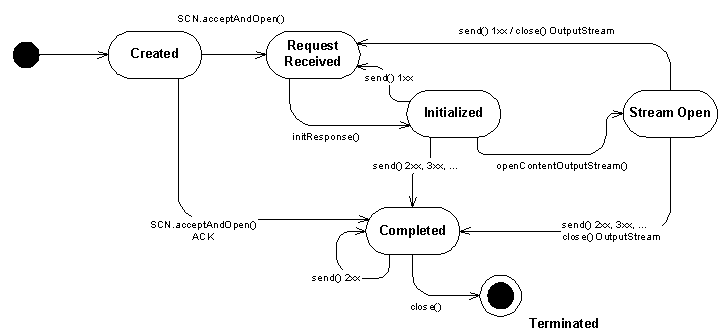
SipServerConnection created. SipServerConnection returned from
SipConnectionNotifier (not ACK).
or provisional response(s) (1xx) sent.initResponse()OutputStream opened with
openContentOutputStream(). Opening InputStream for
received request does not trigger state transition.SipServerConnection for ACK returned from SipConnectionNotifierNote: The state diagram of SipServerConnection
differs from the state diagram of SIP server transaction, which can be found in
RFC 3261 [1] p.136-140
Following methods are restricted to certain states. The table below shows the list of methods available per state.
initResponseopenContentInputStreamaddHeadersetHeaderremoveHeadersetReasonPhraseopenContentOutputStreamsendOutputStream and SipConnection.sendsend // only for resending 2xx responsesSipException.INVALID_STATE if that is specified
to the method and IOException for those methods
(e.g. methods of Input/OutputStream) that does not have
SipException specified. Methods that don't throw
checked exceptions return without any action or return
null as appropriate.Following methods can be called in every state. The functionality is defined by the method depending on the information availability.
null in
the Terminated state.
getHeadergetHeadersgetRequestURIgetMethodgetStatusCodegetReasonPhrasegetDialogsetErrorListener // can not be called in Terminated stateclose // causes state transition to Terminated stateIf an error response is sent to the INVITE request, the client transaction layer will
generate the ACK automatically on behalf of the transaction user (TU). Now when
this ACK arrives on the server it is not passed up to TU as a new
SipServerConnection. See RFC 3261 [1] p.136 "Figure 7: INVITE server transaction".
If the ACK is not received for the final 2xx response, it is up to the TU (UA core)
to resend 2xx response. In order to resend the 2xx response the
SipServerConnection.send() can be called also in Completed state.
See RFC 3261 [1] p.124 "17 Transactions" and p.135 "17.2.1 INVITE Server Transaction".
Following code example illustrates the usage of SIP server connection: opening, receiving one request (MESSAGE) and sending response:
 public receiveMessage() {
    SipConnectionNotifier scn = null;
    SipServerConnection ssc = null;
    String method = null;

    try {
       // Open SIP server connection and listen to port 5060
       scn = (SipConnectionNotifier) Connector.open("sip:5060");

       // block and wait for incoming request.
       // SipServerConnection is established and returned
       // when new request is received.
       ssc = scn.acceptAndOpen();

      // what was the SIP method
      method = ssc.getMethod();
      if(method.equals("MESSAGE")) {
         // read the content of the MESSAGE
         String contentType = ssc.getHeader("Content-Type");
         if((contentType != null) && contentType.equals("text/plain")) {
            InputStream is = ssc.openContentInputStream();
            int ch;
            // read content
            while ((ch = is.read()) != -1) {
             ...
            }
         }
         // initialize SIP 200 OK and send it back
         ssc.initResponse(200);
         ssc.send();
         ssc.close();
      }
    } catch(Exception ex) {
     // handle IOException, InterruptedIOException, SecurityException
     // or SipException
    }
 }
SipConnectionNotifier,
SipServerConnectionListener,
SipClientConnection| Method Summary | |
|---|---|
void |
initResponse(int code)
Initializes SipServerConnection with a specific SIP response
to the received request. |
void |
setReasonPhrase(java.lang.String phrase)
Changes the default reason phrase. |
| Methods inherited from interface javax.microedition.sip.SipConnection |
|---|
addHeader, getDialog, getHeader, getHeaders, getMethod, getReasonPhrase, getRequestURI, getStatusCode, openContentInputStream, openContentOutputStream, removeHeader, send, setErrorListener, setHeader |
| Methods inherited from interface javax.microedition.io.Connection |
|---|
close |
| Method Detail |
|---|
void initResponse(int code)
                  throws java.lang.IllegalArgumentException,
                         SipException
Initializes SipServerConnection with a specific SIP response
to the received request. The default headers and reason phrase will be
initialized automatically. After this the SipServerConnection
is in Initialized state. The response can be sent.
The procedure of generating the response and header fields is defined in RFC 3261 [1] p. 49-50. At least following headers are set by the method:
    From     // MUST equal the From header field of the request
    Call-ID  // MUST equal the Call-ID header field of the request
    CSeq     // MUST equal the CSeq field of the request
    Via      // MUST equal the Via header field values in the request
                and MUST maintain the same ordering
    To       // MUST Copy if exists in the original request,
                'tag' MUST be added if not present
    Contact  // If the server connection is in shared mode then the
                value is set by the system for REGISTER, INVITE,
                SUBSCRIBE and REFER. The value will be set according
                to the terminal IP settings and the connection's
                properties. If the connection is in the dedicated
                mode then the user part is set to some default value
                (e.g. 'user') which should be overwritten by the
                application.
                Example (dedicated mode),
                  Contact: sip:user@172.21.55.69:5060
                Example (shared mode),
                  Contact: "Mr X" <sip:mrx@172.21.55.69:5060>
These headers will be set on behalf of the user by the implementation
the latest when sending the response. It implies that the header values
may not be available for reading right after the initResponse
method returns. The user may also set (overwrite) these headers, in this
case the values set by the user take precedence over the values set by
the implementation.
See RFC 3261, page 162: Table 2: Summary of header fields, and RFC 3265, 7.1 for header field usage in the SUBSCRIBE and NOTIFY methods, and also RFC 3515, 2.2 for header field usage in the REFER method.
The following rules also apply:
If the system has automatically sent the "100 Trying" response, the 100 response initialized and sent by the user is just ignored.
If the system has automatically sent a response to a MESSAGE request
then this method will throw
SipException.ALREADY_RESPONDED. Systems that implement
the message relay functionality (see RFC3428 - Session Initiation
Protocol (SIP) Extension for Instant Messaging) inside the terminal
may have definitive knowledge that the terminal has already responded
with response code 202.
code - Response status code 1xx - 6xx
java.lang.IllegalArgumentException - if the status code is out of
range 100-699 (RFC 3261 p.28-29)
SipException - INVALID_STATE if the
response can not be initialized, because of wrong state.
ALREADY_RESPONDED if the system has already sent a response to a MESSAGE
request.
void setReasonPhrase(java.lang.String phrase)
                     throws SipException
Changes the default reason phrase.
phrase - the reason phrase to be set. Empty string or null means
that an empty (zero-length) reason phrase will be set.
java.lang.IllegalArgumentException - if the reason phrase is illegal.
SipException - INVALID_STATE if the
response can not be initialized, because of wrong state.
INVALID_OPERATION if the reason phrase can not be set.
|
|||||||||
| PREV CLASS NEXT CLASS | FRAMES NO FRAMES | ||||||||
| SUMMARY: NESTED | FIELD | CONSTR | METHOD | DETAIL: FIELD | CONSTR | METHOD | ||||||||